How to Use Airhead Together With Avi AI
Combine Airhead ATPL question practice with Avi AI explanations. Learn how to tackle difficult questions, use clusters, and deepen your EASA ATPL understanding.
How to Use Airhead Together With Avi AI
Preparing for the EASA ATPL exams takes more than just answering lots of practice questions. Airhead is a question-bank platform that helps students focus on relevant, exam-style questions, while Avi AI offers ATPL-specific explanations and interactive support when you get stuck. This guide shows you how to combine both tools for deeper understanding and more structured exam preparation.
What Airhead Does Well
Airhead ATPL is a question-bank platform used by EASA and UK CAA ATPL students. Its main strengths include:
- Exam-style question practice: Become familiar with the types of questions and distractors you may encounter.
- Examining authority filters: Practise questions relevant to your chosen EASA authority or the UK CAA, where available.
- Recently reported questions: Focus on questions that students have recently seen in real exams (based on user reports).
- Question clusters: Explore groups of similar questions to recognise different ways a concept can be tested.
- Subject and keyword search: Target specific weak areas or topics.
- Practice tests: Simulate exam conditions where supported.
These features can help you prioritise your revision and expose you to a range of question styles you may encounter.
How to Use Airhead’s Examining Authority Filters
Airhead may allow you to filter questions by examining authority—such as a specific EASA authority, all EASA authorities, or the UK CAA. This can help you:
- Prioritise questions reported as relevant to your examining authority.
- See which questions have been reported as appearing in recent exams (based on student feedback).
Important:
- Student-reported exam data is based on user input and may not be complete or fully accurate.
- Use this information to guide your revision, but don’t neglect the full syllabus or underlying concepts.
How to Use Question Clusters Effectively
Airhead’s question clusters group together similar questions. This helps you:
- Recognise different ways the same concept is tested.
- Identify repeated weaknesses or confusion points.
- Separate genuine understanding from answer memorisation.
- Compare how small changes in wording can affect the correct answer.
Tip: Avoid simply memorising the answer patterns in clusters. Focus on understanding the underlying theory and what makes each answer correct or incorrect.
Is Airhead Enough to Pass the EASA ATPL Exams?
Practising with Airhead can be a highly valuable part of ATPL exam preparation, but passing the exams requires more than recognising familiar questions. Key differences include:
- Recognition vs. understanding: You might remember an answer, but can you explain why it’s correct?
- Application: Can you apply your knowledge to a new or differently worded question?
- Distractor analysis: Do you know why the other options are wrong?
A question bank can support your study, but it should not become a substitute for understanding the syllabus.
Airhead and Avi AI: Side-by-Side Comparison
| Feature | Airhead ATPL | Avi AI (ATPL Tutor) |
|---|---|---|
| Main purpose | Question practice | Concept explanation, interactive tutor |
| Exam-style question practice | Yes | No (uses your screenshots) |
| Authority-specific filtering | Yes | No |
| Recently reported question data | Available based on student reports | No |
| Similar-question clusters | Yes | Can help compare via screenshots |
| Concept explanations | Yes (where available) | Yes, when requested |
| Interactive follow-up questions | Not the platform’s main purpose | Yes, designed for this purpose |
| Screenshot discussion | Not an interactive screenshot-tutoring workflow | Yes |
| Explaining incorrect options | Sometimes | Yes, when prompted |
| Identifying prerequisite knowledge | Not primarily designed for this | Can help |
| Best use case | Practice, prioritisation | Deep understanding, resolving uncertainty |
Why Use Airhead Together With Avi AI?
Airhead and Avi AI serve different but complementary roles:
- Airhead helps you decide what to practise, exposes you to exam-style questions, and lets you focus on relevant authorities and clusters.
- Avi AI helps you understand why an answer is correct, why the distractors are wrong, and what theory you might be missing.
This combination is particularly useful when you:
- Review not just incorrect answers, but also those you guessed or found confusing.
- Use clusters to compare similar questions, then use Avi AI to clarify the underlying concept.
Step-by-Step Workflow
Step 1: Select the Relevant Examining Authority
Start by choosing your examining authority in Airhead (e.g., a specific EASA authority, all EASA, or UK CAA, where available). This can help you prioritise questions reported as relevant to your exam.
- Use reported data to guide, not limit, your study.
- Don’t ignore the wider syllabus—exam questions can change and reported data is not complete.
Step 2: Choose a Focused Airhead Session
Decide what you want to practise:
- One subject or topic you find challenging
- Recently reported questions
- A mixed session for broader exposure
- A cluster of similar questions
A clear session goal helps you target your weaknesses and avoid aimless question grinding.
Step 3: Flag More Than Wrong Answers
After each session, review not only your incorrect answers but also:
- Questions you guessed but got right
- Questions where two options seemed plausible
- Questions you can’t confidently explain
- Clusters where similar wording causes confusion
This helps you avoid false confidence from lucky guesses.
Step 4: Compare Similar Questions in the Cluster
Within a cluster, look for:
- What stays the same across questions
- Which detail changes the correct answer
- Whether the learning objective is the same
- Which distractors keep appearing
This helps you spot subtle differences and understand the examiner’s intent.
Step 5: Take a Clear Screenshot
When you’re unsure about a question or cluster, take a screenshot that includes:
- The complete question stem
- All answer options
- Any relevant diagram or figure
- Enough context to understand the question
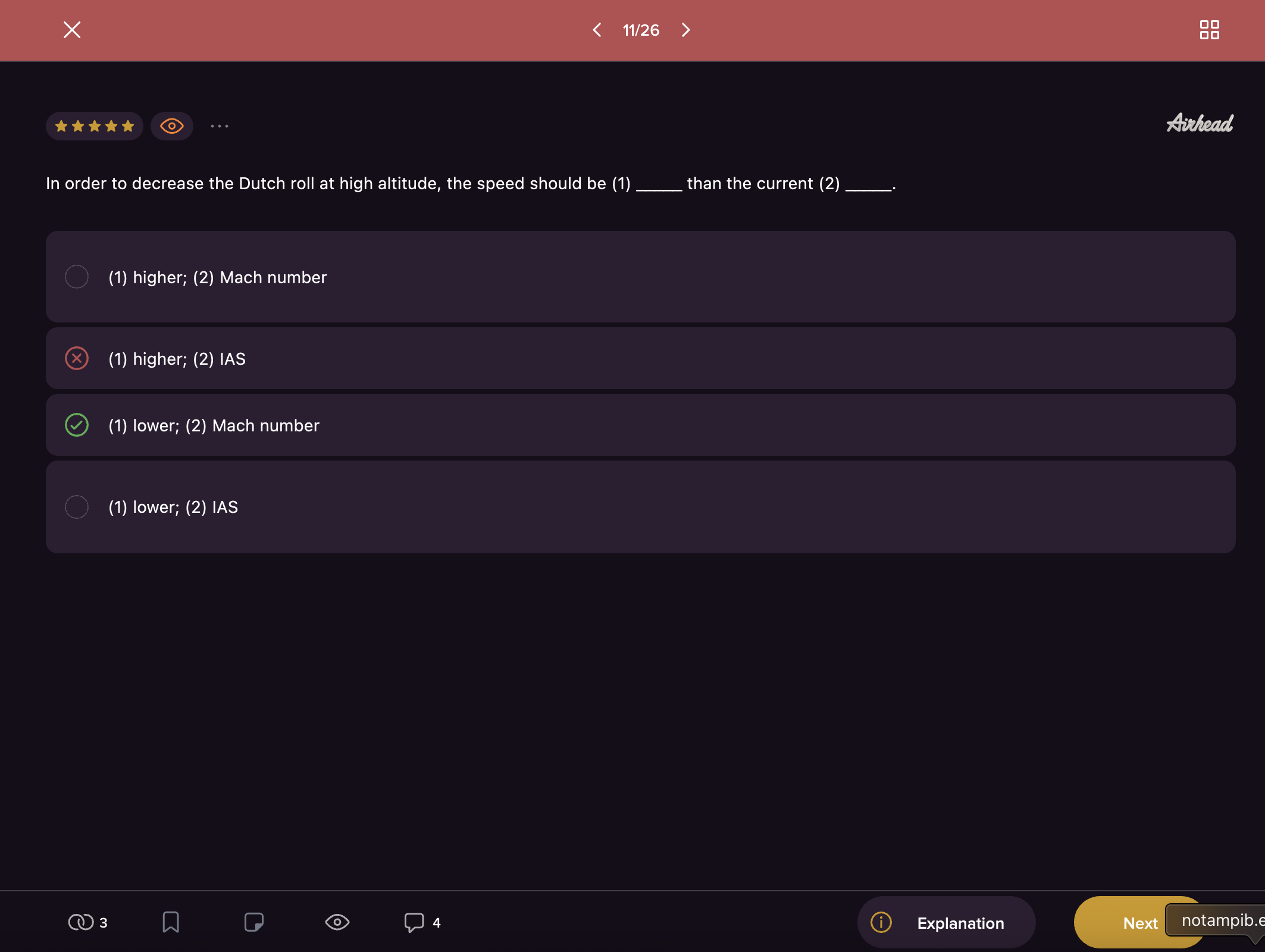
Disclaimer: Use screenshots only where permitted by the question bank’s terms and solely for your own private study. Do not publish, share or redistribute proprietary question content.
Step 6: Upload the Screenshot to Avi AI
Upload your screenshot to Avi AI and ask for an explanation. Avi AI is built specifically for EASA ATPL study and grounds its explanations in ATPL-specific theory, official EASA learning objectives, and concepts reflected across real exam references.
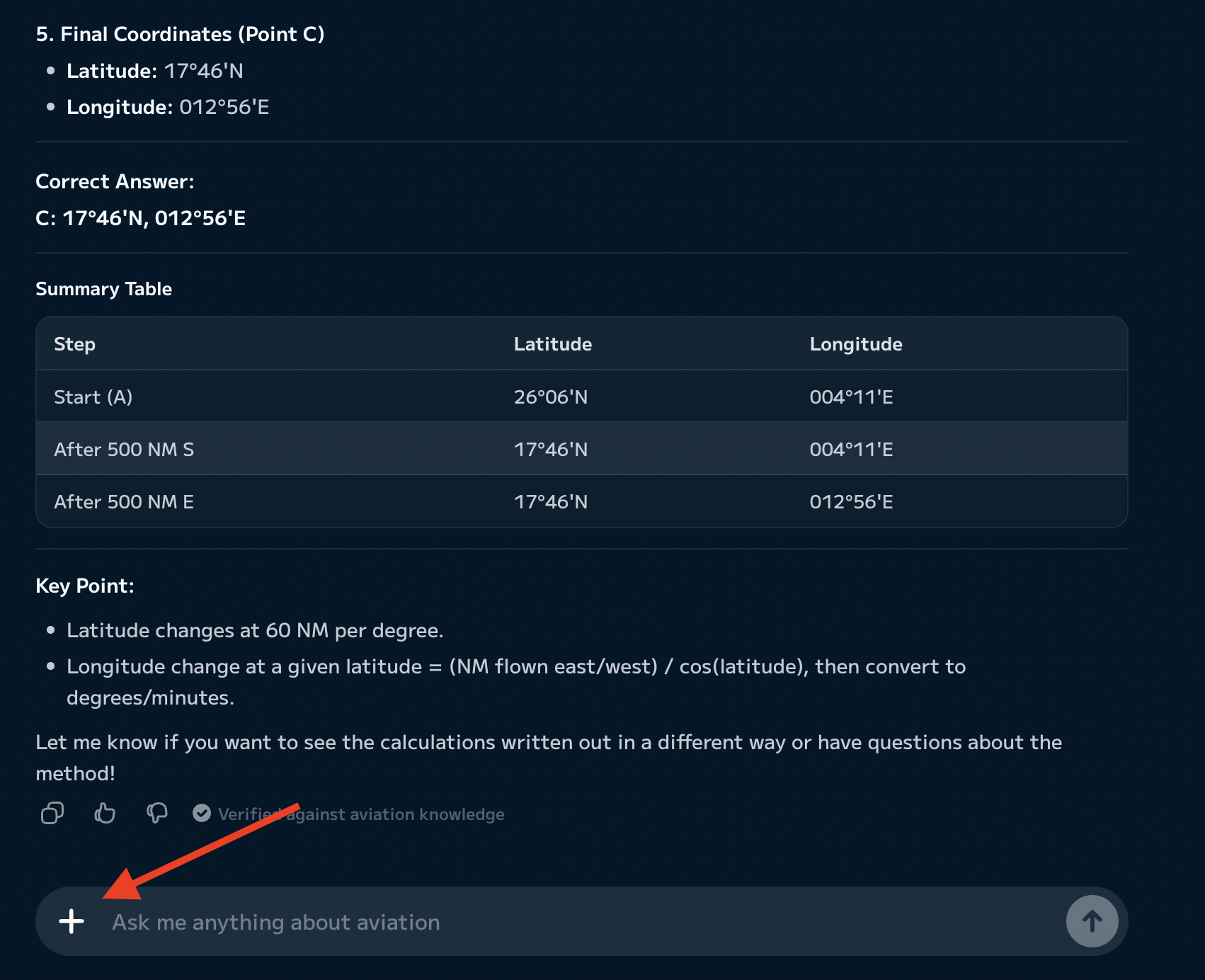
Step 7: Ask Why Every Option Is Right or Wrong
Use a prompt like:
"Explain why option C is correct and why A, B and D are wrong. What ATPL concept is this question testing?"
Analysing every option helps you understand the examiner’s traps and the decisive details.
Step 8: Compare Alternative Formulations
If you have two similar questions (from a cluster), ask Avi AI:
- “Which detail in this question determines the correct answer?”
- “How could the same concept be tested with different wording?”
- “What would need to change for option B to become correct?”
- “Are these two similar questions testing the same concept?”
- “Why does the answer change between these two questions?”
This deepens your understanding of how concepts are examined.
Step 9: Record a Short Takeaway
After reviewing the explanation, write a brief note on:
- The underlying concept
- The decisive detail
- Why you were uncertain
- Any distractor or examiner trap
- What theory you need to review
Step 10: Revisit the Cluster Later
Return to the cluster after some time and attempt the questions again, this time focusing on reasoning rather than memory. This active recall and spaced review can help reinforce your understanding.
Practical Example: Comparing Similar Questions
Scenario:
You’re practising Airhead questions on centre of gravity (CG) and aircraft stability.
- You answer a question about how moving the CG aft affects longitudinal stability. You select “Decreases stability” and get it right.
- In the same cluster, you find a similar question: “What is the effect of moving the CG forward?” You answer “Decreases stability” again, but this time it’s incorrect.
- You realise you assumed the questions were the same. You take screenshots of both.
- You upload both to Avi AI and ask: “Which condition changes the answer, and what concept is being tested?”
- Avi AI explains that moving the centre of gravity aft generally reduces longitudinal static stability, while moving it forward generally increases longitudinal static stability. A forward centre of gravity may also reduce controllability and affect aircraft performance. The explanation highlights how the examiner may reverse the condition to test understanding.
- You note: “Aft CG = less stable; forward CG = more stable, but may affect controllability. Examiner often reverses the condition.”
- Next time, you answer a similar question by reasoning through the concept, not by recalling the previous answer pattern.
How to Use Recently Reported Questions Without Creating False Confidence
Airhead’s recently reported questions feature can help you:
- Prioritise revision on topics that have appeared in recent exams (based on student feedback).
However:
- Do not assume the same question or wording will appear in your exam.
- Student reports are helpful but not comprehensive.
- Do not neglect other syllabus areas.
Use recent-question data to focus your revision, then use Avi AI to ensure you understand the underlying concepts, not just the answer pattern.
Why This Workflow Helps With ATPL Exam Preparation
Combining Airhead and Avi AI can help you:
- Compare similar question formulations and spot decisive wording
- Correct misconceptions and understand distractors
- Review both wrong and uncertain answers
- Avoid memorising answer patterns
- Apply concepts to new or unfamiliar questions
- Identify and fill gaps in prerequisite knowledge
This approach helps build the understanding needed to handle differently worded questions and unpredictable exam conditions.
Common Mistakes When Using Airhead
Be aware of these common study-method mistakes:
- Relying only on recently reported questions
- Selecting an authority and ignoring the wider syllabus
- Memorising clustered questions without understanding
- Completing large numbers of questions without reviewing uncertainty
- Focusing only on scores
- Reviewing only incorrect answers
- Assuming similar-looking questions have the same answer
- Treating student-reported exam data as a guarantee
- Failing to investigate why distractors are wrong
These are mistakes in study approach, not faults in Airhead itself.
Useful Prompts for Avi AI
Copy and use these prompts to get more value from Avi AI:
- “Explain why option C is correct and why A, B and D are wrong.”
- “What ATPL concept is this question actually testing?”
- “Which exact word or condition determines the correct answer?”
- “Why do these two similar questions have different answers?”
- “Are these questions testing the same learning objective?”
- “What prerequisite knowledge am I missing?”
- “How could the examiner word this differently?”
- “What would need to change for option B to become correct?”
- “Give me a simpler explanation before using technical terminology.”
- “Ask me one follow-up question to check whether I understood it.”
- “Which common exam trap is used in this question?”
How Avi AI Differs From General AI Tools
Avi AI is built specifically for EASA ATPL study and grounds its explanations in ATPL-specific theory, official EASA learning objectives, and concepts reflected across real exam references. This means:
- Explanations are more exam-focused and relevant
- Every answer option can be discussed in detail
- Decisive wording and examiner traps are highlighted
- You can compare similar questions and ask follow-up questions
- Missing prerequisite concepts can be identified
- Explanations can be connected to related concepts across the broader ATPL syllabus
Avi AI is not a generic chatbot and does not have access to Airhead’s private content. It is designed to complement, not replace, your question-bank practice.
Conclusion
Airhead helps you practise and prioritise relevant, exam-style ATPL questions. Avi AI supports your revision by helping you investigate difficult questions and strengthen your understanding of the concepts behind each answer. The most effective workflow uses Airhead’s reported-question data and clusters as prioritisation tools, while Avi AI helps you build the understanding needed for exam success.
Try using Avi AI during your next Airhead review session to investigate difficult questions and strengthen your understanding.
Common questions
Airhead is a valuable tool for practising exam-style questions and prioritising revision, but passing requires understanding the underlying concepts, not just recognising answers. Use Airhead alongside deeper study and tools like Avi AI to ensure you can explain and apply your knowledge.
You can use Airhead for question practice and Avi AI to investigate difficult or confusing questions. This combination can help you move beyond memorisation and develop a stronger grasp of the theory.
You can upload screenshots for your own private study, provided this is permitted by Airhead’s terms. Do not publish, share or redistribute proprietary question content. Avi AI can help explain the theory behind the question and analyse all answer options.
Yes. You can upload screenshots of two similar questions and ask Avi AI to explain which detail changes the answer, what concept is being tested, and why the examiner might use different wording.
No. Avi AI is not a question bank and does not provide full exam practice. It is a complementary ATPL-specific AI tutor designed to help you understand difficult questions and concepts.
Use authority filters to focus on questions relevant to your exam. However, don’t limit your study too narrowly—ensure you cover the full syllabus and understand the underlying concepts, as exam questions can vary.
No. Recently reported questions are useful for prioritisation, but relying only on them can leave gaps in your knowledge. Use them as a starting point, then review the full syllabus and use Avi AI to deepen your understanding.
Yes. The workflow of practising questions, flagging uncertainty, uploading screenshots, and using Avi AI for explanations works with other question banks as well.
There’s no fixed number. Focus on quality over quantity: review your answers, investigate uncertainty, and ensure you understand the concepts behind each question. Use clusters and Avi AI explanations to reinforce your learning.
Turn confusion into understanding
Use Avi AI alongside ATPLQ, AviationExam or Airhead to understand the questions you get wrong.
Start free